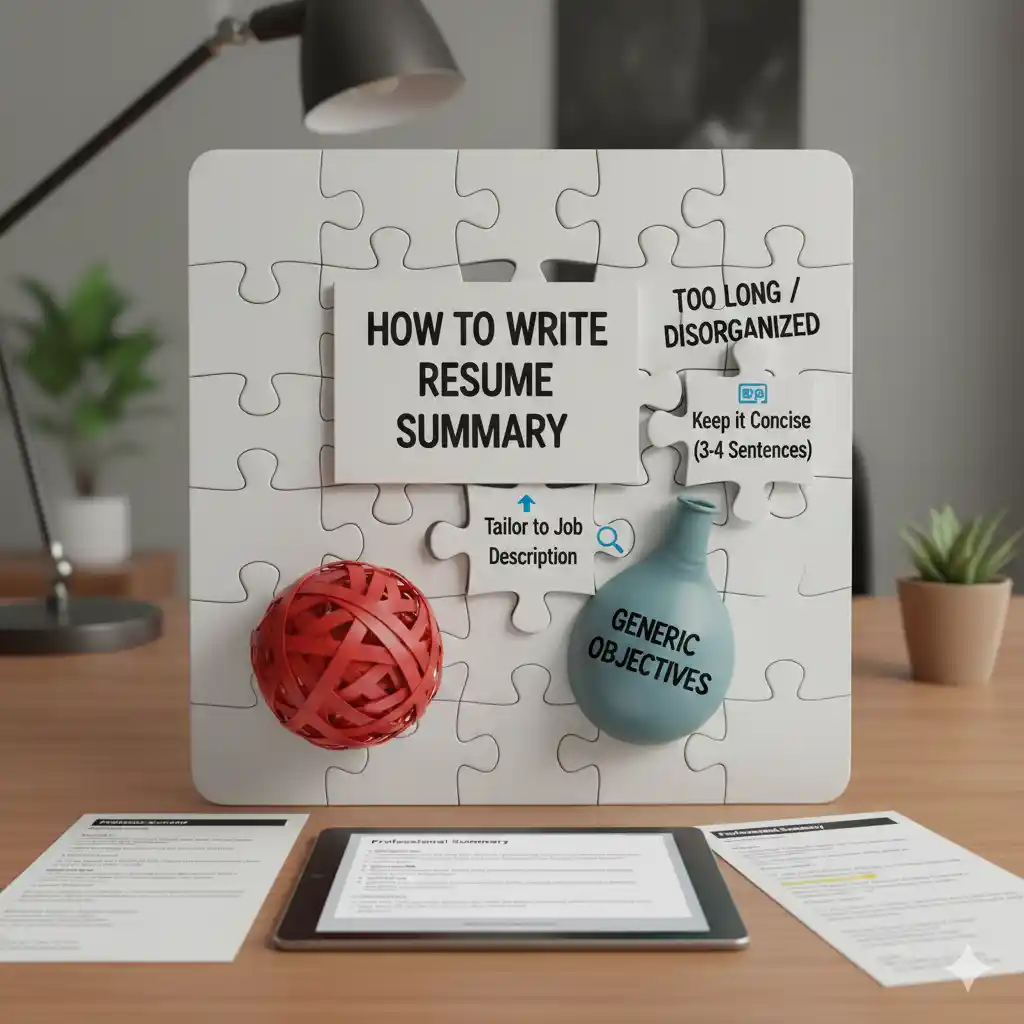
What is a Resume Summary?
A resume summary (also called a professional summary or career summary) is a brief statement at the top of your resume that highlights your most relevant qualifications, experience, and achievements. It's typically 2-4 sentences and gives recruiters a quick overview of your value proposition.
A well-written resume summary can make the difference between getting your resume read or tossed aside. In this comprehensive guide, we'll show you how to write an effective resume summary that grabs attention and showcases your value.
Resume Summary vs. Resume Objective
Understanding the difference between a summary and an objective is crucial:
Resume Summary:
- Highlights your experience and achievements
- Best for experienced professionals
- Focuses on what you bring to the table
- Emphasizes your value proposition
Resume Objective:
- States your career goals
- Best for entry-level candidates or career changers
- Focuses on what you want
- Less commonly used today
For most job seekers, a resume summary is the better choice. It demonstrates your value immediately and shows what you can contribute to the organization.
Why Resume Summaries Matter
Recruiters spend an average of 6-7 seconds scanning a resume. Your summary is the first thing they read, making it critical for:
- Grabbing Attention: A compelling summary encourages recruiters to read further
- ATS Optimization: Keywords in your summary help you rank in applicant tracking systems
- Setting Context: Provides immediate context for your experience
- Showing Relevance: Demonstrates why you're a good fit for the role
Key Elements of an Effective Resume Summary
1. Years of Experience
Mention your total years of experience or expertise level:
- "Experienced marketing professional with 8+ years..."
- "Entry-level software developer with strong foundation in..."
- "Senior executive with 15 years of leadership experience..."
2. Core Skills and Expertise
Highlight 2-4 key skills most relevant to the position:
- Technical skills for tech roles
- Industry expertise for specialized positions
- Soft skills that differentiate you
- Tools and technologies you master
3. Notable Achievements
Include quantifiable achievements when possible:
- Revenue increases or cost savings
- Projects led or completed
- Awards or recognition
- Process improvements
4. Value Proposition
Explain what you bring to the organization:
- How you solve problems
- What makes you unique
- Your approach to work
- Industry knowledge or specialization
How to Write a Resume Summary: Step-by-Step
Step 1: Analyze the Job Description
Before writing your summary:
- Identify key requirements and qualifications
- Note important keywords and phrases
- Understand the company's needs
- Determine what experience is most relevant
Step 2: Identify Your Key Strengths
Brainstorm your most relevant:
- Years of experience in the field
- Core skills and expertise
- Major achievements and accomplishments
- Unique value propositions
Step 3: Write Your First Draft
Create 2-4 sentences that include:
- Your experience level
- Core competencies
- Notable achievements
- Value you bring
Step 4: Refine and Optimize
Edit your summary to:
- Keep it concise (2-4 sentences, 3-5 lines)
- Use action-oriented language
- Include relevant keywords
- Quantify achievements
- Remove filler words
Resume Summary Examples by Experience Level
Entry-Level Resume Summary
Example 1 - Recent Graduate:
"Motivated Computer Science graduate with hands-on experience in full-stack web development through academic projects and internships. Proficient in JavaScript, React, and Node.js with strong problem-solving abilities and collaborative mindset. Seeking to leverage technical skills and passion for innovation in a software engineering role."
Example 2 - Career Starter:
"Enthusiastic marketing professional with proven ability to drive engagement through social media campaigns and content creation. Demonstrated success increasing social media followers by 200% during internship. Skilled in analytics, content strategy, and brand management. Ready to contribute creative ideas and data-driven insights to a marketing team."
Mid-Level Professional Summary
Example 1 - Marketing Manager:
"Results-driven Marketing Manager with 6 years of experience developing and executing integrated marketing campaigns that drive revenue growth. Proven track record of increasing brand awareness by 40% and generating $2M+ in qualified leads. Expert in digital marketing, content strategy, and marketing automation tools. Strong analytical skills and data-driven decision-making approach."
Example 2 - Software Engineer:
"Full-stack Software Engineer with 5+ years of experience building scalable web applications using modern technologies. Expertise in React, Node.js, and cloud platforms (AWS). Led development of microservices architecture improving system performance by 50%. Passionate about clean code, agile methodologies, and mentoring junior developers."
Senior-Level Professional Summary
Example 1 - Senior Executive:
"Strategic Senior Executive with 15+ years of leadership experience driving organizational transformation and revenue growth in Fortune 500 companies. Successfully led cross-functional teams of 50+ members, delivering $10M+ annual cost savings through process optimization. Expert in change management, strategic planning, and stakeholder engagement. Proven ability to execute complex initiatives that drive business results."
Example 2 - Technical Director:
"Visionary Technical Director with 12 years of experience leading engineering teams and architecting enterprise-scale solutions. Successfully scaled engineering organization from 10 to 100+ engineers while maintaining high code quality and delivery velocity. Expert in cloud architecture, DevOps practices, and agile transformation. Proven track record of building high-performing teams and delivering innovative products."
Career Changer Resume Summary
Example:
"Accomplished teacher transitioning to instructional design with 8 years of experience creating engaging educational content and curriculum. Strong foundation in learning theory, content development, and project management. Successfully designed and implemented training programs for 500+ students. Seeking to leverage teaching expertise and passion for learning design in a corporate instructional design role."
Industry-Specific Resume Summary Examples
Healthcare
"Compassionate Registered Nurse with 7 years of clinical experience in emergency and critical care settings. Specialized in patient assessment, medication administration, and emergency response. Maintained 99% patient satisfaction scores and contributed to reducing hospital readmissions by 15%. Committed to providing exceptional patient care and continuous professional development."
Finance
"Analytical Financial Analyst with 5 years of experience in financial modeling, budgeting, and strategic analysis. Proven ability to identify cost-saving opportunities totaling $3M+ annually. Expert in Excel, SQL, and financial software. Strong attention to detail and ability to communicate complex financial data to stakeholders at all levels."
Sales
"Top-performing Sales Professional with 8 years of experience exceeding quotas in B2B software sales. Consistently ranked in top 10% of sales team with $5M+ in annual revenue. Expert in consultative selling, relationship building, and CRM management. Proven ability to identify customer needs and deliver tailored solutions that drive business growth."
Common Resume Summary Mistakes
1. Being Too Generic
Bad: "Hard-working professional seeking challenging position."
Good: "Experienced project manager with 8 years leading cross-functional teams to deliver complex initiatives on time and under budget."
2. Focusing on What You Want
Bad: "Seeking a position that allows me to grow my career."
Good: "Results-driven professional who brings 10 years of experience and proven track record of success."
3. Using Clichés
Avoid overused phrases like:
- "Team player"
- "Go-getter"
- "Results-oriented" (without proof)
- "Detail-oriented" (without examples)
4. Making It Too Long
Keep your summary concise:
- 2-4 sentences maximum
- 3-5 lines on the page
- 50-150 words
- Easy to scan quickly
5. Not Customizing for Each Job
Tailor your summary by:
- Including keywords from the job description
- Emphasizing relevant experience
- Highlighting matching skills
- Adjusting your value proposition
Keywords and ATS Optimization
Your resume summary is prime real estate for keywords. To optimize for ATS systems:
- Use Job Description Keywords: Include important terms from the posting naturally
- Industry Terminology: Use standard industry language
- Skills and Technologies: Mention relevant tools and competencies
- Job Titles: Include your target role title if appropriate
Example: If the job requires "Python, data analysis, and machine learning," ensure these terms appear naturally in your summary.
Action Verbs for Resume Summaries
Start sentences with strong action verbs:
- Led, Managed, Developed, Created, Implemented
- Increased, Improved, Optimized, Reduced, Enhanced
- Achieved, Exceeded, Delivered, Generated, Produced
- Designed, Built, Launched, Executed, Transformed
Tips for Writing a Compelling Summary
1. Lead with Your Strongest Point
Start with your most impressive qualification or achievement.
2. Use Numbers and Metrics
Quantify achievements when possible to show impact.
3. Be Specific, Not Vague
Provide concrete examples rather than generic statements.
4. Match the Job Requirements
Align your summary with what the employer is looking for.
5. Show Enthusiasm
Demonstrate genuine interest in the role and company.
Resume Summary Checklist
Before finalizing your summary, verify:
- ✅ 2-4 sentences, 50-150 words
- ✅ Includes years of experience
- ✅ Highlights core skills and expertise
- ✅ Mentions notable achievements
- ✅ Uses action verbs
- ✅ Includes relevant keywords
- ✅ Quantifies achievements when possible
- ✅ Customized for the specific job
- ✅ Free of typos and grammatical errors
- ✅ Focuses on value to employer
Conclusion
A well-crafted resume summary is your opportunity to make a strong first impression. By following these guidelines and using our free resume builder, you can create a compelling summary that showcases your value and encourages recruiters to read further.
Remember: Your summary should be a powerful snapshot of your professional value. Take time to craft it carefully, customize it for each application, and ensure it accurately represents your expertise and achievements.
Ready to create a standout resume? Browse our free resume templates with pre-formatted summary sections. No credit card required.
For more resume writing tips, visit our career blog or check our pricing page for premium features.